11 Retrieval access and disclosure
Retrieval controls determine which records may reach the employee, model provider, and other recipients, including after permissions or stored copies change.
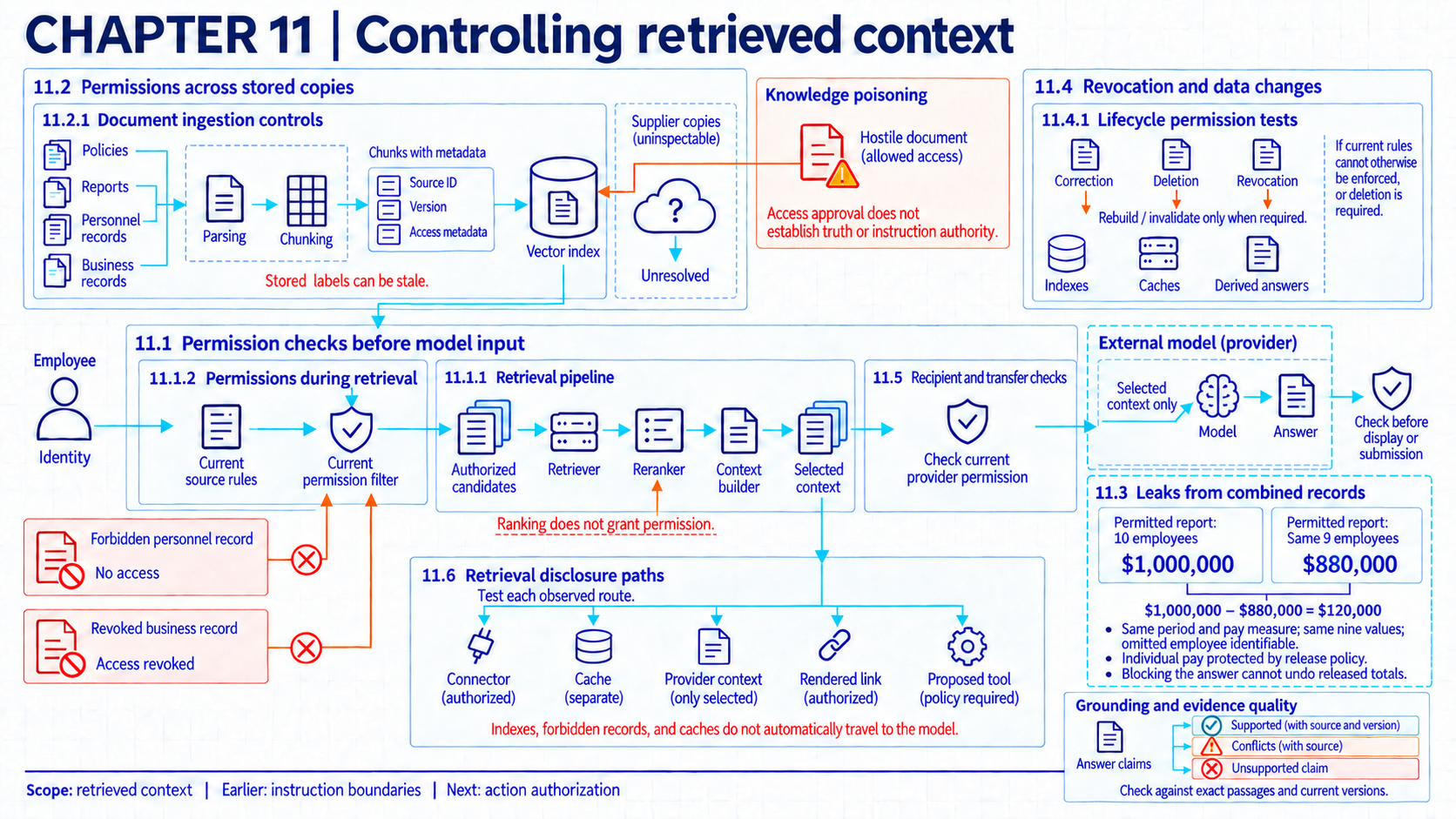
Suppose an employee sends a request to an assistant about the travel reimbursement limit. Similarity search returns three candidates: the current travel policy the employee may read, a payroll record the employee may not read, and a business draft the employee could read yesterday but can no longer access. Assume the external model provider may process only the current policy for this request. The application should admit only the current policy into the model request, and it should check again before displaying the answer, because permissions can change between the two moments. A useful answer built from the wrong records is still a disclosure failure.
Whether a retrieved passage is true or hostile is a different question, answered in Chapter 5 (RAG and search poisoning). The broader disclosure paths in Chapter 6 (Data leakage and privacy attacks) include transfers and retained copies as well as information inferred from model queries. For each candidate and each copy, the team still must check whether this user may receive it through this request. Retrieval here works as described in Chapter 5. An ingestion job prepares chunks, and an index stores them with their source versions. A retriever and reranker select candidates, and context assembly formats the model input. The threat record from Chapter 2 (Threat modeling and controls) fixes what the attacker can change. A stale copy or a missed permission change can expose information even when nobody is trying to cause a leak.
11.1 Permission checks before model input
PromptArmor1 reported on August 20, 2024, that Slack AI could combine text from a public channel with messages from private channels in one answer. An attacker’s public message steered the answer built from the private messages. A link in that answer could then carry private data out of the workspace if the employee clicked it. The report shows that the path worked, not how often anyone used it. Each message came from a place with its own readers, yet all of it entered one model context, and the answer could carry it to an outside address.
The question is where the application checks a document before it enters that context. Two designs enforce this boundary at different points. Permission-aware filtering can narrow the eligible set before ranking. If that filter correctly applies the current rules and covers every input route, it keeps forbidden candidates out of the ranker. Access to other copies and logs still requires separate controls. A second design ranks a broader set inside a service authorized to process those records. It then applies the employee and destination checks before exposing candidate text, scores, or identifiers to any recipient lacking that access. Otherwise filtering comes too late, because the forbidden record has already crossed to a new recipient. An external reranker or model provider receiving candidates is itself a recipient with its own permission question, treated in Recipient and transfer checks. Neither order prevents every forbidden copy, cache entry, or log line on its own. Each remaining store needs its own check.
11.1.1 Retrieval pipeline records
Retrieval-augmented generation is useful when an answer depends on information outside the model’s fixed parameters. The security decision is which stored material may become part of the current user’s model input. Each stage keeps the record the next check needs. The trace notes the query, the employee identity, candidate chunk identifiers, the ranking result, the access decision, the assembled context, the model version, and the answer. A failure at any step can change what the model sees without changing the user’s words.
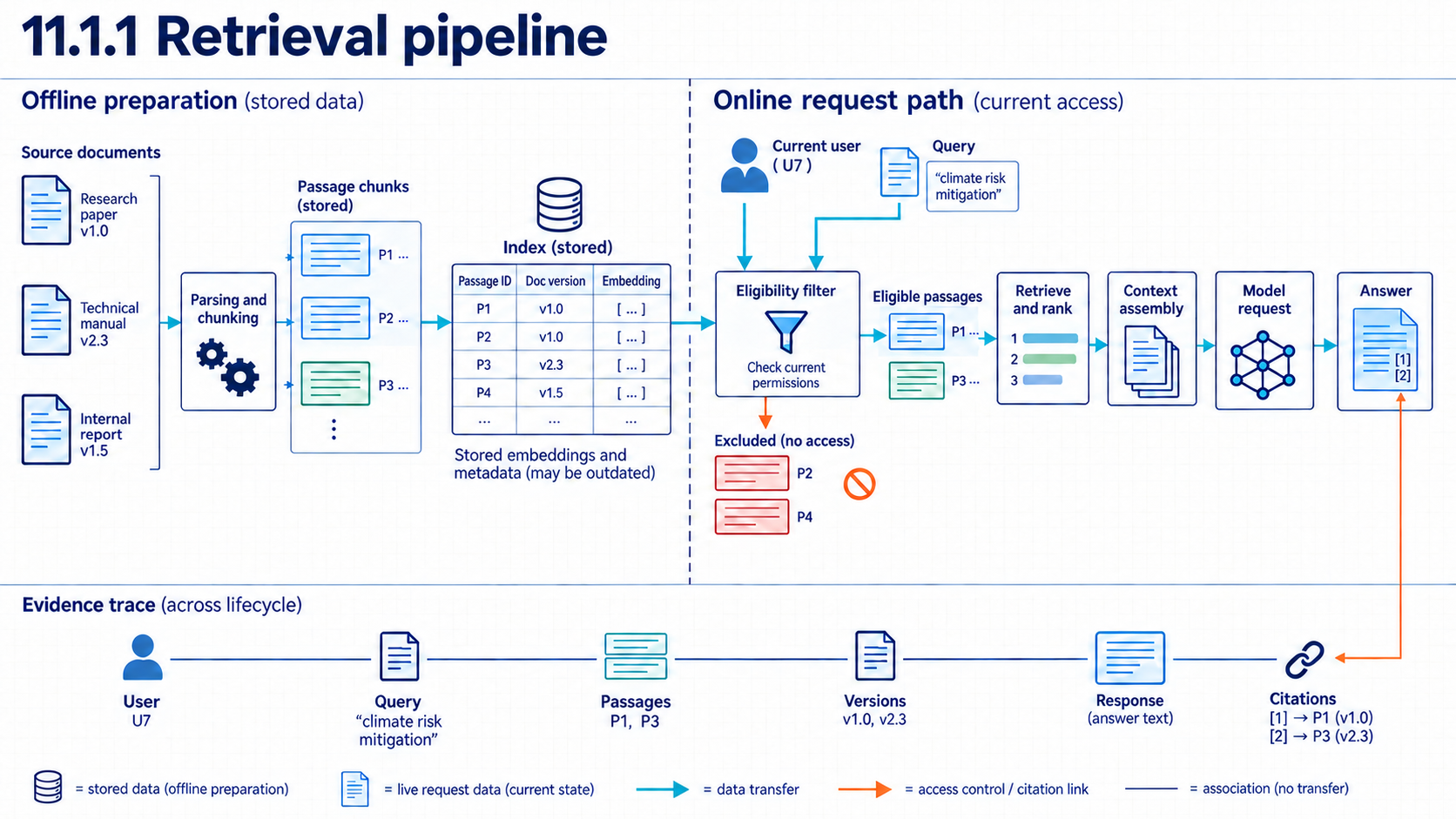
Where the mapping from a chunk to its source object is missing, the service should deny the candidate until the source mapping is repaired. An unmapped chunk cannot pass a permission check. Cache entries that cannot be tied to a current rule should be invalidated, policy data refreshed before the decision, and the affected derived store rebuilt where a rebuild is needed. Extra checks add latency and can lower retrieval recall, the fraction of relevant records returned, when records are incomplete.
11.1.2 Permission checks during retrieval
Search relevance does not answer whether the current employee may read a result. The access service decides from three inputs: the current employee identity, the chunk-to-source mapping, and the current access rule. Tenant and department labels can narrow search, but the authoritative decision still belongs to the organization’s access-control system.
NIST zero trust guidance2 calls for least-privilege, per-session access to resources and states that access to one resource does not grant access to another. NIST zero trust guidance3 also describes decisions that use the subject, requested resource, service, and device rather than network location alone. A retrieval application must still map document and chunk identifiers to the real authorization system. In this design, context assembly should receive only text permitted for the employee and the model provider. Checking again before delivery narrows the time gap in which a permission can change. It does not remove races in general or recover data already sent to the provider. The organization states which snapshot and version each check uses and how old a policy reading may be, without assuming one atomic design fits every deployment. Allowed content still needs a separate trust check, since permission says nothing about truth.
Example
Filtering three candidates for one employee. Suppose employee E17 asks about the travel policy. The ranking step runs inside the authorized retrieval service: no candidate text, score, or identifier reaches the employee, an external reranker, or the model before the access decision. Similarity search returns three candidate records: chunk-44 from travel-policy-v5 with similarity 0.91, chunk-82 from executive-travel-draft with 0.88, and chunk-17 from travel-faq-v2 with 0.79.
Assume the access service allows the policy and the FAQ but denies the draft under the current rule, so context assembly records only chunk-44 and chunk-17. Before delivery, the service checks both source objects again and receives two allow decisions. Suppose the recorded context and serialized provider request contain only the two allowed chunks, and the recorded answer cites those sources without the synthetic marker from the denied draft. These observations support the exclusion of that draft from the inspected request and answer. They do not establish that unrelated logs, caches, or other copies exclude it. The record also confirms that this provider is permitted to receive both admitted chunks.
| Rank | Chunk | Source object | Similarity score | Access decision | Context result |
|---|---|---|---|---|---|
| 1 | chunk-44 |
travel-policy-v5 |
0.91 | allow | included |
| 2 | chunk-82 |
executive-travel-draft |
0.88 | deny | excluded |
| 3 | chunk-17 |
travel-faq-v2 |
0.79 | allow | included |
When the rule changes, the same trace runs again under the new rule and reports forbidden chunks excluded over all forbidden candidates with allowed chunks returned over all allowed candidates. Rechecking costs latency and can reduce availability when the policy service fails, and a derived store can bypass the rule if its access path is not covered by the recheck.
11.2 Permissions across stored copies
A chunk allowed once does not stay allowed by itself. Index entries, embeddings, caches, and conversation histories carry the content forward along new access paths. Each path needs an enforceable link to the current rule: stored labels checked while still fresh, or a live lookup at request time. Stored labels alone can go stale, so a label recorded yesterday does not settle today’s request. Revocation removes future access under a changed rule. It is distinct from erasing every copy and from reversing a reading that already happened. Deletion, correction, and revocation are separate outcomes with separate tests. Model parameters enter this path only where training explicitly writes them. Ordinary retrieval indexing does not update weights.
11.2.1 Source and permission records
Before retrieval can enforce access or show evidence, ingestion has to preserve what the source is and which version entered the index. The ingestion record links each chunk to the source system, source object, version, parser, extraction time, and access labels. Parser isolation and file-type checks limit damage during processing. Intake checks follow Chapter 7 (Supply chain compromise), and isolating the parser’s execution follows Chapter 8 (Isolation on shared infrastructure). International secure AI guidance4 recommends checking and sanitizing inputs and documenting data, models, and system decisions across development. Where a chunk’s source mapping is ambiguous, the chunk should be denied until reingestion or a repaired record restores the link. Source links can sometimes be reconstructed that way, but a missing label never authorizes access.
A privacy inventory of data actions, elements, purposes, and processing environments supports the same register from the exposure side (NIST Privacy Framework5). The general copy inventory in Chapter 6 (Data leakage and privacy attacks) records purpose, recipient, retention, and deletion evidence per copy. Retrieval applies that register to derived copies. There the question is not only where copies sit but which derived copies each changed permission update must cover during propagation.
11.3 Leaks from combined records
Permission to release individual records does not by itself establish that all information inferable from their combination is suitable for release. The relevant restriction must be explicit: it may concern the recipient, the purpose, or a protected fact. Detecting such a conflict can reveal a problem in the source-release policy as well as in answer generation.
Example
Information from overlapping reports. Suppose a permitted report gives annual base pay of $1,000,000 for ten employees. A second permitted report covers the same period and pay measure for nine of those employees, totaling $880,000. The employee omitted from the second report is identifiable, and the other nine values are unchanged. Subtracting the totals reveals $120,000 for that employee.
Assume the organization’s release policy is intended to protect individual pay. Blocking an assistant from displaying the subtraction cannot remove information already available in the two reports. The organization would need to reconsider which overlapping totals it releases and to whom. The inference discussion in Chapter 6 (Data leakage and privacy attacks) explains why checking each answer separately may miss information learned across releases.
11.4 Revocation and data changes
Retrieval security changes over time even when application code is unchanged. A document can be corrected or deleted. An employee can lose access, and a connector can be revoked. An old answer can remain in a cache. The organization needs a deadline for enforcing each changed permission and separate evidence for any required deletion or correction. Successful revocation does not establish that the stored bytes are gone.
11.4.1 Revocation, deletion, and correction tests
The NIST Generative AI Profile6 recommends tracking data-set deletion and correction and examining effects on records about content sources. NIST media-sanitization guidance7 distinguishes the sanitization method from verification and validation of its result.
A lifecycle test creates and indexes a synthetic document. It confirms authorized retrieval before removing the employee’s access, then repeats the query against indexes and caches. A second test deletes or corrects the source and checks each derived store against a stated deadline. The deletion trace in Chapter 6 (Data leakage and privacy attacks) covers source, index, cache, conversation, backup, and provider copies. Retrieval tests apply that method to derived stores. There, reindexing, cache invalidation, deletion propagation, and connector revocation decide whether forbidden context persists. Short deadlines increase processing cost and can interrupt service during rebuilds. An unregistered cache or supplier copy can remain outside the route, so the organization records inaccessible supplier evidence as a limit. Passing cannot prove deletion from a component the organization cannot inspect.
A changed access rule can block future retrieval without deleting a document that other employees may still use. Purging a cache or rebuilding an index is needed only where its design cannot otherwise apply the new rule correctly, or where deletion is separately required. Tests report forbidden returns after revocation and the delay until each covered path enforces it. Deletion tests examine the tracked copies instead. An interim access block can limit exposure during repair. Supplier-held copies require supplier action and evidence. Repeating a test after a missed deadline does not erase the earlier delay.
11.5 Recipient and transfer checks
A final boundary sits where retrieved information leaves the organization: the serialized request to an external model provider and any submitted tool request carrying retrieved text outward. Field checks, connector scope, and destination controls act at different boundaries and need separate enforcement points.
Connector scopes restrict what a service can fetch, following the least-privilege and separation-of-duties outcomes the Privacy Framework8 calls for. NCSC guidance9 recommends controls before potentially sensitive information is sent to an external API. The exact serialized provider request remains the evidence. A seeded disclosure test in Chapter 6 (Data leakage and privacy attacks) shows which seeded fields a provider request contains. Retrieval marks which admitted chunks contributed to the outgoing payload. A connector that sends data before the check, or an encoded passage the content rule misses, bypasses the control.
Answer assembly needs its own recipient check, separate from the retrieval-time employee check. The assembled answer, its citations, and any proposed tool call go to specific recipients, so the service verifies each recipient against the current rule before display, logging, or submission. Where the operation needs another identity’s authority, that approval check belongs to Chapter 12 (Agent action authorization). What the organization sends, and what it can still verify afterward, also bounds the later evidence. Permission states observed at retrieval and return feed live operation (Chapter 15). Supplier duties for provider-held copies belong to Chapter 21 (Responsibility and legal duties). The following test checks these transfer paths together. Chapter 14 (Evidence for release decisions) develops the broader evaluation method.
11.6 Disclosure path testing
Disclosure can occur before, during, or after model generation. An overbroad connector may ingest material the application should never see. A stale permission filter may place forbidden text in context. A shared cache can return another user’s result, while an answer, fetched link, or submitted tool request can carry sensitive text to a new destination. Caller, model provider, tools, logs, and the answer recipient may each hold different permissions for the same text, so each transfer needs its own recipient check.
OWASP10 lists disclosure, altered content, unauthorized function access, and command execution as possible consequences of prompt injection. The indirect-prompt-injection study by Greshake et al.11 includes demonstrations where manipulated content produced information-bearing links or triggered connected application calls. Its synthetic applications used prepared responses and could not contact real systems. Those paths depend on the permissions and rendering behavior of the tested applications.
Apply the data handling test to this retrieval path, retaining current employee, source version, and permitted recipient with each event. Inspect both generated tool arguments and submitted tool requests so a proposal is not mistaken for a transfer. The connector, access service, cache, renderer, and action gateway enforce their own boundaries using source, user, destination, and request state. Report synthetic disclosures over all eligible cases containing a synthetic marker and clean completions over all ordinary cases. A missing marker supports only the monitored routes, including the provider payload where inspected. Tracing costs storage and can itself expose sensitive content. An uninstrumented cache, alternate output channel, or reused identifier can hide a leak.
Note
Chapter checkpoint. Suppose an employee requests the current travel limit. Search ranks one allowed policy, one forbidden draft, and one allowed but older FAQ. What must the retrieval record show before the answer can be accepted?
Answer. Link each chunk to its source object and version, record the employee identity, preserve the ranking, and show the access decision that excluded the forbidden draft. Record the final assembled context and repeat authorization before delivery. Then compare each material answer claim with the exact allowed passages, using the support method taught in Chapter 5 (RAG and search poisoning). Apply the organization’s rule for choosing the current version. This evidence supports the tested answer path. It does not establish source authenticity, complete cache invalidation, or general grounding accuracy.
PromptArmor (2024), “Data Exfiltration from Slack AI via Indirect Prompt Injection,” PromptArmor, August 20, 2024, source. A researcher demonstration against one product at one point in time. It shows a working path, not its use by attackers.↩︎
Scott Rose, Oliver Borchert, Stu Mitchell, and Sean Connelly (2020), Zero Trust Architecture, NIST SP 800-207, section 2.1, tenet 3, printed p. 6, source. The publication gives an architecture principle. It does not define retrieval filters or show that filtering after retrieval prevents disclosure.↩︎
Scott Rose, Oliver Borchert, Stu Mitchell, and Sean Connelly (2020), Zero Trust Architecture, NIST SP 800-207, section 2.1, tenets 1 and 4-6, printed pp. 6-7, source. A retrieval application must still map document and chunk identifiers to the real authorization system.↩︎
UK National Cyber Security Centre, CISA, and international partners (2023), Guidelines for Secure AI System Development, version 1.0, November 27, section 1, “Design your system for security,” p. 10, and section 2, “Document your data, models and prompts,” p. 12, source. The guidance does not specify parser isolation, optical-character-recognition checks, metadata schemas, or version-selection rules.↩︎
National Institute of Standards and Technology, NIST Privacy Framework: A Tool for Improving Privacy through Enterprise Risk Management, version 1.0 (2020), NIST CSWP 01162020, Appendix A, Table 2, ID.IM-P4-P7, printed p. 20, source. The framework does not supply an AI-specific list of prompts, embeddings, feedback, caches, and logs.↩︎
National Institute of Standards and Technology (2024), Artificial Intelligence Risk Management Framework: Generative Artificial Intelligence Profile, NIST AI 600-1, action MG-4.1-006, printed p. 44, source. The action does not define a propagation deadline or prove deletion from every index, cache, model, or supplier store.↩︎
Ramaswamy Chandramouli and Eric A. Hibbard (2025), Guidelines for Media Sanitization, NIST SP 800-88 Rev. 2, section 4.5, “Sanitization Assurance,” especially sections 4.5.1-4.5.2, printed pp. 24-25, source. Media sanitization does not by itself address logical copies in indexes, derived embeddings, supplier backups, or model weights.↩︎
National Institute of Standards and Technology, NIST Privacy Framework: A Tool for Improving Privacy through Enterprise Risk Management, version 1.0 (2020), NIST CSWP 01162020, Appendix A, Table 2, PR.AC-P4, printed p. 26, source. The outcome does not prove that a particular connector scope or redaction rule is sufficient.↩︎
UK National Cyber Security Centre, CISA, and international partners, Guidelines for Secure AI System Development, version 1.0 (2023), Secure design, “Design your system for security as well as functionality and performance,” PDF p. 10, source. Design guidance. It does not evaluate any specific data-loss-prevention product.↩︎
OWASP GenAI Security Project (2025), Top 10 for LLM Applications 2025, LLM01:2025, “Prompt Injection,” description and “Types of Prompt Injection Vulnerabilities,” impact list, source. The categories are a study aid, not proof that a listed failure occurred or that the categories are independent in practice.↩︎
Kai Greshake et al. (2023), “Not What You’ve Signed Up For: Compromising Real-World LLM-Integrated Applications with Indirect Prompt Injection,” Proceedings of the Sixteenth ACM Workshop on Artificial Intelligence and Security (AISec), 79-90, DOI. Author manuscript arXiv:2302.12173v2, author-manuscript section 4.2, PDF pp. 6-10, source. The demonstrated paths depend on the permissions and rendering behavior of the tested applications.↩︎