Part VI: Implementation and Extensions
Images, audio, and table fields have different structures. Conversion into numerical inputs needs to preserve the structure required by the task. Those arrays then need storage layouts and operations that preserve their intended meaning. An experiment additionally needs evidence about the required task, beyond a valid tensor calculation.
Chapter 22 develops local image operations, image-text comparisons, sampled audio, and table-field representations. Chapter 23 follows logical axes into physical storage, copies, devices, and training-state lifetimes. Chapter 24 connects these mechanisms to the experiments in the linked notebooks and the evidence their conclusions require.
The classifier in Chapter 24 follows a loss through its gradients into a checked parameter update. Evaluating the same rows verifies that local calculation; a claim about new inputs needs a separate held-out comparison. The execution reference retains the environment and notebook settings needed to attempt those larger experiments.
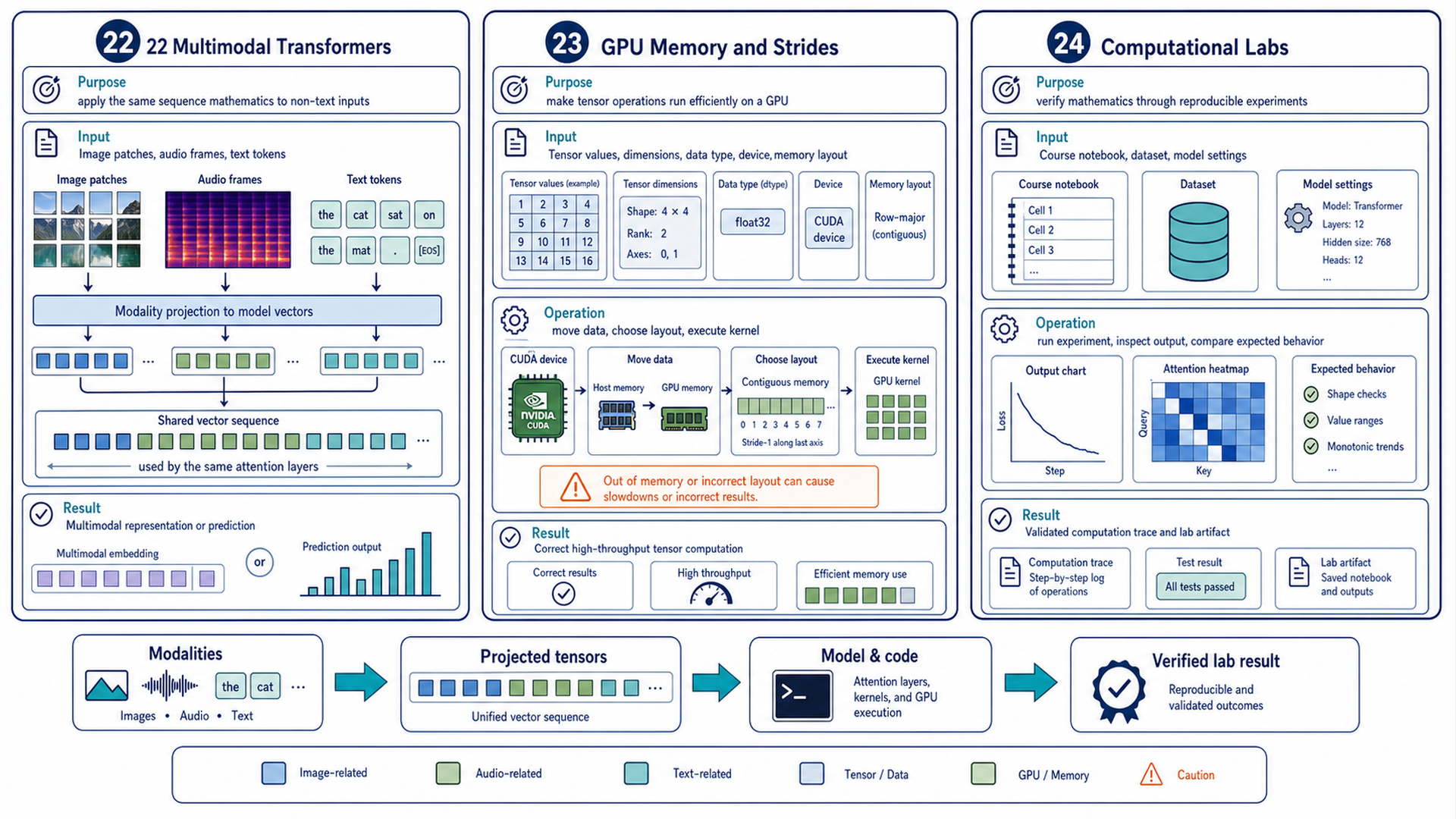
Chapters in this part
- Images, audio, and tables: Representations and tasks: Images, audio, and table fields need representations that preserve the structure required by their distinct output tasks.
- Tensor storage: Shapes, views, devices, and lifetime: Tensor memory and execution claims need storage, layout, numerical type, device, and state lifetime beyond logical shape.
- Computational labs: Checks, experiments, and evidence: Training and inference experiments declare their inputs, procedures, and comparison rules so results can support the intended claims.